
AP26197431 – Development of designs and technologies for high-precision deformation monitoring in space infrastructure using fiber Bragg gratings
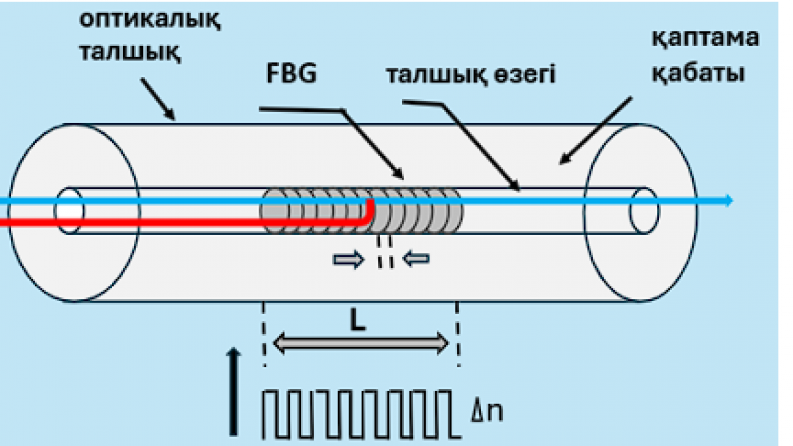
Objective of the project – to develop and verify methods for measuring high-speed mechanical and thermal deformations on metal and composite structures using a multifunctional sensor based on fiber optic Bragg gratings.
Relevance: The relevance of the project is driven by the need to improve the reliability and accuracy of measurements under the influence of destabilizing factors such as impacts, vibrations, temperature fluctuations, and mechanical damage, particularly in the space industry. Modern materials and structures used in spacecraft require detailed investigation of their strength and deformation characteristics under high-speed and impulse loads. In this context, fiber Bragg gratings (FBG), characterized by high sensitivity, fast response, and immunity to electromagnetic interference, are of particular interest. The use of FBG enables the measurement of high-speed deformations and the determination of material failure thresholds under extreme conditions. The development of new measurement techniques and the application of fiber-optic sensors provide opportunities for more accurate modeling of structural behavior under impact loads. Overall, the project is aimed at advancing modern diagnostic technologies, thereby enhancing the safety and efficiency of space technologies and other strategically important sectors.
Scientific supervisor: Ph.D., Professor, Sauletbek Zholdykarauuly Koshkinbayev
Expected and achieved results: Within the framework of the project, a scientific and technical concept of a fiber-optic sensor for registering high-speed deformations on metallic surfaces has been developed. The key parameters of the sensor, requirements for materials and design, and a preliminary structural scheme for its operation under impulsive mechanical and magnetic loads have been defined. A patent analysis has been conducted, identifying existing technical solutions and outlining promising directions for further research. Initial CAD models of the pulsed magnetic field generation system and experimental setup components have been created, and technical requirements for subsequent testing have been established. The scientific novelty of the obtained results lies in the development of a sensor concept capable of detecting deformations under pulsed magnetic pressure and integrating with Bragg gratings. It is expected that the project will lead to the development of effective methodologies and technologies for detecting high-speed shear on metallic surfaces, including elements of spacecraft. The development and implementation of fiber-optic sensors in monitoring systems across various sectors, such as the space industry, testing facilities, and energy sector, are planned. The project includes the publication of scientific papers in high-ranking journals, the release of a monograph, and obtaining a patent. It is also expected to contribute to human resource development, including the completion of at least one PhD dissertation. Overall, the project will enhance scientific and technical capacity, expand commercialization opportunities, and support the implementation of innovative solutions in strategically important sectors of the Republic of Kazakhstan.
List of publications with links to them
- Көшкінбаев С.Ж., Смайлов Н.К., Сейтханова А.К., Жаңатайұлы Ж.
Ғарыш инфрақұрылымындағы деформацияны FBG сенсорларымен дәл бақылау // Л.Н. Гумилев атындағы Еуразия ұлттық университетінің хабаршысы. – Астана, 2025. – Т. 3152. – № 3. – Б. 41–55. – DOI: https://doi.org/10.32523/2616-6836-2025-152-3-41-55. – ISSN 2663-1296. - Көшкінбаев С.Ж., Сейтханова А.К., Жаңатайұлы Ж., Кошкинбаева М.Ж., Дуйсенов Н.Ж.
FBG арқылы ғарыш инфрақұрылымын жоғары дәлдікпен бақылау // Вестник Торайгыров университета. – Павлодар, 2025. – Т. 3. – № 3. – Б. 169–183. – DOI: https://doi.org/10.48081/10.48081/FZTY8271. – ISSN 2959-068X.