
AP23485052 – Development of methodology for studying fine and nanoscale gold in ores of primary deposits, placers and products of their processing
Objective of the project – is to develop methodology for studying fine and nanoscale gold in ores of primary deposits, placer sands and products of their processing, which will allow to increase gold reserves of Kazakhstan.
Relevance: The relevance of the project is determined by the need to increase the efficiency of gold extraction through the study of fine and nanoscale gold, which is difficult to detect using traditional methods. Currently, existing analytical approaches do not allow reliable determination of the distribution and occurrence forms of such gold in ores and placers. Its dispersed occurrence and ability to migrate within weathering crusts present significant challenges, requiring the development of new research methodologies. The widespread presence of gold nanoparticles in sulfide minerals highlights the importance of their detailed study to improve recovery rates. For unconventional deposits containing ultrafine and dust-like gold, modern high-precision analytical methods are especially necessary. Therefore, the development of effective methods for studying fine and nanoscale gold is a relevant task aimed at increasing the gold reserves and developing the mineral resource base of the Republic of Kazakhstan.
Scientific supervisor: Ph.D., Associate Professor, Omarova Gulnara
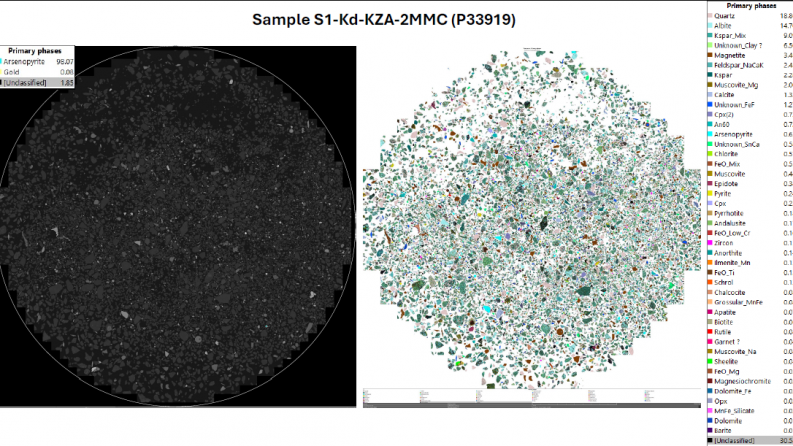
Expected and achieved results: During the implementation of the project, field studies were conducted, resulting in a detailed investigation of the mineral composition of rocks associated with placer gold mineralization. Mineralized zones were identified, and samples were collected for further analytical studies. The collected materials made it possible to determine visual mineralogical and petrographic criteria for identifying mineralized areas, as well as to develop a program for further research. Fieldwork was carried out at the Yrgayty, Zholbarysty, and Kelinshaktau deposits, where representative samples were collected. In laboratory conditions, a комплекс of analytical studies was performed, including granulometric, spectral, chemical, and atomic absorption analyses. In addition, fire assay, scintillation, X-ray phase, and phase chemical analyses were conducted, allowing the determination of mineral composition and gold content in the samples. Thin sections and polished sections were prepared for micromineralogical studies. Some of the samples were analyzed at the Natural History Museum in London using advanced equipment (SEM, LA-ICP-MS, Tescan TIMA), which made it possible to determine the forms of gold occurrence and the composition of gold-bearing phases. As a result of the research, paragenetic relationships between gold and other elements such as silver, bismuth, tellurium, and arsenic were established. Typomorphic features and chemical composition of gold, including characteristics of “new” gold in placer and primary deposits, were identified. For the first time, data on the occurrence forms of fine and nanoscale gold were obtained, demonstrating high practical significance. A preliminary mechanism for the formation and aggregation of gold nanoparticles was developed, including processes of weathering, transport, deposition, and accumulation in placers. It was shown that gold formation is influenced by a combination of hydrodynamic, mechanical, and geochemical processes, which allows refinement of deposit formation conditions and improves the efficiency of their exploration and development.