
AP19679905 — Study of high-temperature degradation processes during fermentation in two-phase lithium ceramics as blanket materials for ITER
Purpose: To study the mechanisms of high-temperature degradation during the accumulation of damage caused by the introduction of hydrogen in lithium ceramics, as well as to determine the effect of interfacial boundaries on the resistance to ceramic degradation.
Relevance: The study of degradation processes in two–phase lithium ceramics of the type Xli₄sio₄ - (1-x)Li₂tio₃ is relevant for the development of reliable and radiation-resistant materials in the field of thermonuclear energy. These ceramics are considered as promising target materials for tritium generation, and understanding their behavior under the influence of hydrogen at high temperatures is critical for improving the service life and efficiency of future power plants.
Scientific supervisor: Ph.D., Saulet Askerbekov
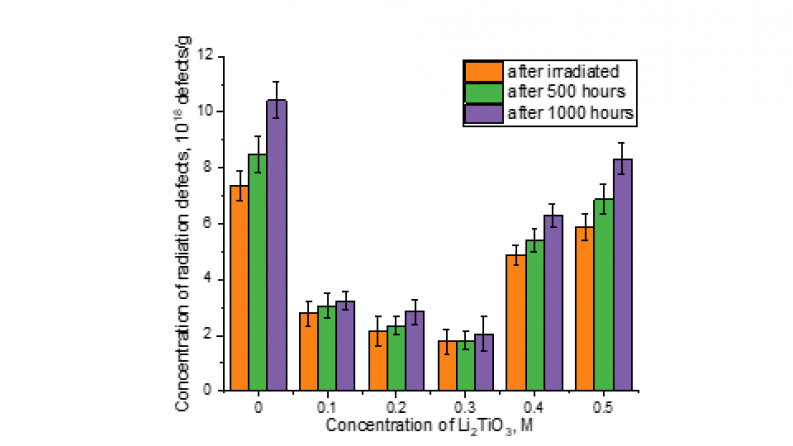
Results obtained: Within the framework of this research, a comprehensive study was conducted on the effect of phase composition in Li₄SiO₄–Li₂TiO₃ ceramics on their radiation resistance under high-dose proton irradiation. A two-stage mechanism of radiation damage accumulation dependent on irradiation fluence was identified, along with the key role of increased Li₂TiO₃ content in reducing defect concentration and radiolysis products. The influence of composition on thermal properties was analyzed, demonstrating improved thermal conductivity and resistance to degradation with Li₂TiO₃ addition. Post-irradiation thermal annealing processes were investigated, revealing partial or complete defect relaxation depending on their type and concentration. Using EPR spectroscopy, the mechanisms of defect formation and the effect of irradiation temperature on structural changes were determined. The obtained results contribute to optimizing material compositions for enhanced performance in tritium generation systems.
List of publications with links to them
- Kenzhina I.E., Askerbekov S., Kozlovskiy A.L., Tolenova A., Piskunov S., Popov A.I. The influence of accumulated radiolysis products on the mechanisms of high-temperature degradation of two-component lithium-containing ceramics // Ceramics. – 2025. – Vol. 8, No. 3. – Article 99. – DOI: https://doi.org/10.3390/ceramics8030099.
- Kozlovskiy A.L., Kenzhina I.E., Tolenova A., Askerbekov S. Study of the effect of the component ratio variation in two-phase ceramics on the resistance to high-dose proton irradiation simulating the effects of hydrogen swelling // Eurasian Physical Technical Journal. – 2025. – Vol. 22, No. 1. – P. 5–18. – DOI: https://doi.org/10.31489/2025N1/5-18.
- Samarkhanov K.K., Khasenov M.U., Batyrbekov E.G., Skakov M.K., Gradoboev A.V., Bedenko S.V., Vega-Carrillo H.R., Kenzhina I.E., Askerbekov S.K., Kozlovskiy A.L., Zaurbekova Zh.A., Shaimerdenov A.A., Begentayev M.M., Tolenova A.U., Abshurikova A.M. Nuclear-excited source of coherent and incoherent radiation with direct nuclear pumping // Applied Radiation and Isotopes. – 2024. – Vol. 214. – Article 111503. – DOI: https://doi.org/10.1016/j.apradiso.2024.111503.
- Kenzhina I.E., Kozlovskiy A.L., Chikhray Y., Kulsartov T., Zaurbekova Z., Begentayev M., Askerbekov S. Study of gas swelling processes under irradiation with protons and He²⁺ ions in Li₄SiO₄–Li₂TiO₃ ceramics // Crystals. – 2023. – Vol. 13. – Article 1526. – DOI: https://doi.org/10.3390/cryst1310152