
AP19679572 — Development of a new technology for the utilization of zinc dust from steelmaking industries with the production of marketable products
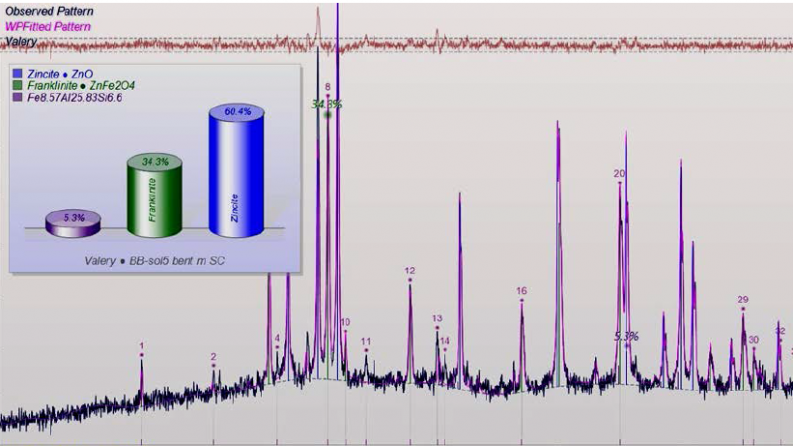
Purpose: Investigation of the physico-chemical bases of zinc extraction from clinker by sintering it with calcium chloride. Technological experiments on the extraction of zinc from clinker. To achieve this goal, the following tasks have been solved: Studies of the forms of metals in clinker have been conducted. The method of processing clinker to produce commercial zinc dust was selected and justified; a thermodynamic analysis of the solid-phase interaction of clinker components with calcium chloride was carried out.; Laboratory experiments were conducted to study the effect of temperature, reducing agent consumption, and process duration on the distribution of zinc and related metals between clinker sintering products with calcium chloride; the results were evaluated. A general technological scheme has been developed for processing zinc dust to produce commercial products.
Relevance: Due to the lack of a rational technology for processing zinc dust with a high lead content, they are not used on an industrial scale and accumulate in large volumes. The developed technology will stimulate the development of Pb, Zn and steel production by involving ferrous metallurgy in the processing of lead-containing zinc dust to produce commodity products with high added value. The development of lead-containing zinc dust processing facilities will have a positive impact on expanding the range of marketable products in their traditional production and increase their export potential.
Scientific supervisor: Ph.D., Associate Professor, Gulzada Koishina
Results obtained: Within the conducted research work, low- and high-temperature chlorinating roasting processes were investigated for the selective recovery of lead and zinc from complex dust materials. Thermodynamic and technological parameters of the processes using NH4Cl and CaCl2 were determined, and optimal operating conditions were established. As a result of magnetic separation and subsequent treatment, an iron-rich product as well as high-quality lead and zinc fumes were obtained. Phase transformations and metal distribution behavior among the products were analyzed, enabling the identification of selective extraction mechanisms. Laboratory and pilot-scale experiments demonstrated high efficiency and reproducibility of the developed technology. The obtained results confirm the strong potential for industrial implementation of the proposed process.
List of publications with links to them
- Koishina G., Zholdasbay E., Argyn A., Icheva Yu., Kurmanseitov M., Dosmukhamedov N. Iron extraction from dust from scrap metal smelting in electric arc furnaces by magnetic separation // Metallurgist. – 2024. – Vol. 7. – P. 1–7. – DOI: https://doi.org/10.1007/s11015-024-01818-y.
- Dosmukhamedov N., Koishina G., Zholdasbay E., Kurmanseitov M. Lead extraction in low-temperature dust roasting during metal scrap melting in electric arc furnace together with ammonium chloride // CIS Iron and Steel Review. – 2024. – Vol. 28. – P. 104–109. – DOI: https://doi.org/10.17580/cisisr.2024.02.18; https://rudmet.net/media/articles/Article_CIS_2024_28_pp.104-109.pdf.
- Koishina G.M., Dosmukhamedov N.K., Kaplan V.A., Zholdasbay E.E., Argyn A.A., Icheva Yu.B. Extraction of zinc from dust from electric arc furnaces by high-temperature chlorinating sintering // Engineering Journal of Satbayev University. – 2024. – Vol. 146(4). – P. 8–15. – DOI: https://doi.org/10.51301/ejsu.2024.i4.02; https://vestnik.satbayev.university/index.php/journal/article/view/1363/655.
- Koishina G., Tazhiyev E., Daruesh G., Zholdasbay E., Myrzabekova K. Behaviour of impurities during high-temperature firing of sinter obtained after selective extraction of lead from dust together with calcium chloride // Satbayev International Conference. – 2024. – Vol. 24, Issue 1. – P. 89–95. – DOI: https://doi.org/10.51301/SIC.2024.i1.13.
- Koishina G., Argyn A., Tazhiev Ye., Zholdasbay E. Investigation of the material composition of lead- and zinc-containing dust of ferrous metallurgy // IX International Scientific and Practical Conference “Questions, hypotheses, answers: science XXI century”. – 2024. – Toronto, Canada. – P. 88–92. – DOI: https://doi.org/10.5281/zenodo.12688843.
- Koishina G., Argyn A., Tazhiev Ye., Zholdasbay E. Investigation of the effect of temperature, ammonium chloride consumption and process duration on the extraction of lead into commercial distillates // X International Scientific and Practical Conference “Theoretical and practical perspectives of modern science”. – 2024. – Stockholm, Sweden. – P. 68–73. – DOI: https://doi.org/10.5281/zenodo.12745671.
- Dosmukhamedov N.K., Koishina G.M., Zholdasbay E.E., Argyn A.A., Icheva Yu.B. Enlarged laboratory experiments of ferrous metallurgy dust sintering with calcium chloride // Complex Use of Mineral Resources. – 2025. – Vol. 335(4). – P. 59–66. – DOI: https://doi.org/10.31643/2025/6445.40; https://kims-imio.com/index.php/main/article/view/478/484.
- Koishina G., Dosmukhamedov N., Kaplan V., Nursainov I., Zholdasbay Ye. Technology for producing pure lead-free zinc oxide from electric arc furnace (EAF) dust // Engineering Journal of Satbayev University. – 2025. – Vol. 147(2). – P. 17–23. – https://vestnik.satbayev.university/index.php/journal/article/view/1452.
- Koishina G., Zholdasbay E., Argyn A., Nursainov I., Dosmukhamedov N. Impurity behavior in low-temperature sintering products of ironmaking dust in the presence of ammonium chloride // Metallurgist. – 2025. – Vol. 4. – P. 90–95. – DOI: https://doi.org/10.1007/s11015-025-01975-8; https://link.springer.com/article/10.1007/s11015-025-01975-8.
- Dosmukhamedov N.K., Nursainov I.N., Koishina G.M., Zholdasbay E.E., Kaplan V.A. Lead and zinc distribution in chloridizing sintering of zinc dust obtained after processing of different kinds of raw materials in the iron and steel industry // Non-ferrous Metals. – 2025. – No. 1. – P. 3–9. – DOI: https://doi.org/10.17580/nfm.2025.01.01; https://rudmet.net/media/articles/Article_NFM_01_25_pp.3-9.pdf.
- Заявка на патент РК «Способ получения чистого, не содержащего свинца и кадмия, оксида цинка, из пыли электродуговой плавки вторичной стали». Авторы: Досмухамедов Н.К., Жолдасбай Е.Е., Каплан В., Қойшина Г.М., Кұрмансейтов М.Б., Тажиев Е.Б., Нурсаинов И.Н. – № 2025/0494.1 от 27.05.2025 г.