
Laboratory of Metallurgical Processes, Thermal Engineering and Powder Metallurgy
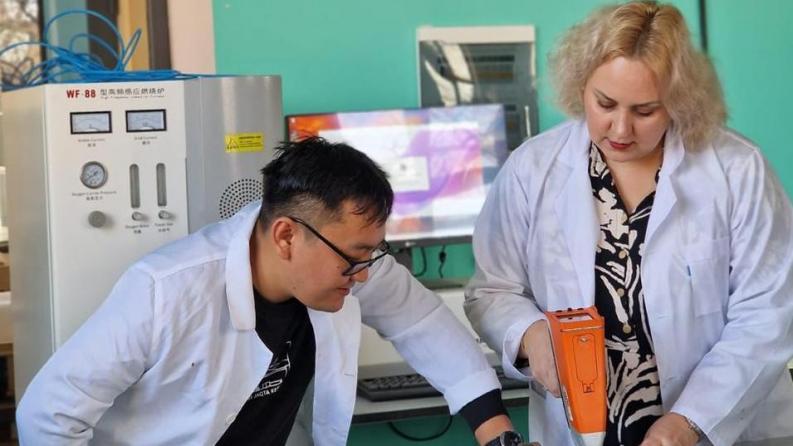
Scientific Supervisor: PhD, Associate Professor Chepushtanova T.A.
Objective — to study the processes of thermal decomposition of metallurgical raw materials; to determine optimal conditions for roasting and smelting processes; to optimise hydrometallurgical processes; to select reagents; to conduct physicochemical studies on pyro- and hydrometallurgical research objects; to perform thermal engineering calculations in support of metallurgical processes; to produce finished powder metallurgy products; and to obtain specialty materials in the form of non-ferrous metal powders, refractories, and special-purpose alloys.
Laboratory tasks:
- X-ray fluorescence analysis and determination of the chemical composition of ore and non-ore raw materials (stationary and portable modes);
- Roasting under vacuum, oxidising and reducing atmospheres (rotary vacuum tubular furnace). Continuous thermal decomposition of ore and technogenic raw materials, as well as non-ferrous metal concentrates. This equipment enables research conducted in conditions close to industrial production. The primary focus is on the production of rare, non-ferrous, and precious metals;
- Atomic absorption analysis of metallurgical raw materials; quantitative analysis based on the property of atoms to absorb light at specific wavelengths (resonance absorption); determination of the chemical composition of research objects; a method for determining the chemical composition of substances from atomic absorption spectra of aqueous and non-aqueous solutions;
- Beneficiation of concentrates containing rare and rare-earth elements via a crushing complex, including coarse and fine crushing and grinding of various fractions;
- Thermal analysis of inorganic and organic raw materials; study and determination of phase transitions, mass reduction, dehydration of research objects; determination of heat capacity, reaction orders, and thermal decomposition of powders of various compositions (STA 449 F3 simultaneous thermal analyser);
- Analysis of thermal conductivity, heat capacity, and thermal diffusivity of research objects in extractive and powder metallurgy (LFA 467 HyperFlash®, NETZSCH analyser);
- Determination of thermodynamic and kinetic parameters of roasting, smelting, leaching, and extraction processes; modelling of roasting and smelting processes (STA 449 F3 simultaneous thermal analyser).
Clients: Balausa Firm LLP, Kazakhmys LLP, Kazzinc LLP, Kazatomprom NAC, Altynalmas JSC, KAZ Minerals, Kostanai Minerals JSC, ERG Research Centre LLP, Sokolovsko-Sarbaiskoye Mining and Processing Production Association JSC, Shubarkol Komir LLP, and other subsoil users.
Laboratory's uniqueness — the first laboratory in Kazakhstan to be equipped with a comprehensive set of technological and analytical instruments enabling the resolution of tasks in pyro- and hydrometallurgy, powder metallurgy, and metallurgical thermal engineering; providing turnkey metallurgical technology development, from raw material beneficiation through to the production of special-purpose powder products or alloys; delivering unique results on the thermal decomposition of research objects through forecasting and modelling.
Effectiveness: In 2023 and 2024, contracts were signed with Balausa Firm LLP totalling 12,000,000 tenge. Pilot-scale trials on the thermal decomposition technology for vanadium-bearing raw materials are being conducted on the procured crushing complex equipment, and optimisation of thermal decomposition conditions in the presence of various reagents and their mixtures is being carried out under the targeted programme funding project IRN BR21881939 "Development of Resource-Saving Energy-Generating Technologies for the Mining and Metallurgical Sector and Establishment of an Innovative Engineering Centre." Future projects are planned with ERG and Ust-Kamenogorsk Titanium and Magnesium Plant JSC; the opening of the laboratory is expected to recover the invested costs within five years.
Alignment with the UN Sustainable Development Goals (SDGs):
SDG 4 — Quality Education;
SDG 8 — Decent Work and Economic Growth;
SDG 9 — Industry, Innovation and Infrastructure;
SDG 12 — Responsible Consumption and Production;
SDG 17 — Partnerships for the Goals