
AR19676689 — Dynamic and electrodynamic properties of plasma in an extreme state
Objective of the project: The goal of this project is to study the dynamic and electrodynamic properties of plasma under extreme conditions such as high temperatures, high densities and strong magnetic fields. The main goal is to understand the behavior of plasma under such conditions and identify its features that can be key for a variety of applications, including nuclear physics, astrophysics, nuclear fusion, as well as to develop new technologies and methods for controlling plasma in extreme conditions.
Relevance of the project: The relevance of the project aimed at studying the dynamic and electrodynamic properties of plasma under extreme conditions is confirmed by the following factors: Understanding the dynamic and electrodynamic processes under extreme conditions is necessary to develop methods for controlling plasma in nuclear reactors and to achieve the conditions necessary for thermonuclear fusion, which can become a source clean and safe energy in the future. In extreme space conditions, such as solar wind, plasma jets and magnetic storms, plasma exhibits dynamic and electrodynamic behavior. Studying these phenomena is important for understanding the impact on the space environment and various space technologies. Plasma technologies are used in a variety of fields, including industrial processes, medicine and electronics. Understanding the dynamic and electrodynamic properties of plasma under extreme conditions helps improve the efficiency and reliability of such processes. In general, the study of the dynamic and electrodynamic properties of plasma under extreme conditions is of strategic importance both for fundamental research and for practical application in various fields of science and technology.
Scientific supervisor: Ph.D., Karlygash Dzhumagulova
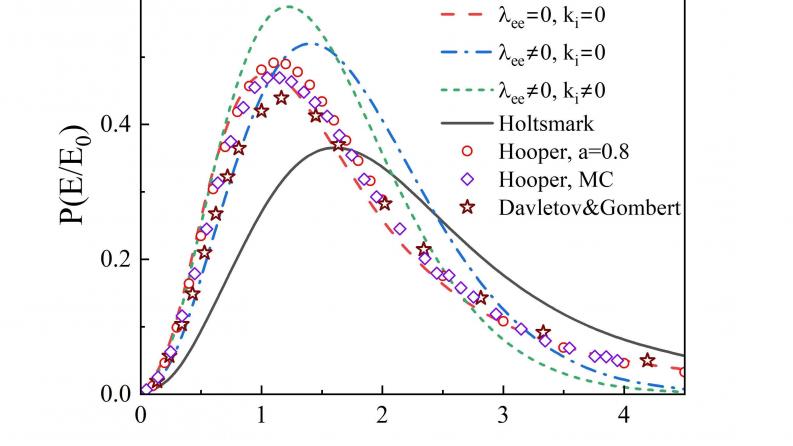
Results obtained: Within the project, theoretical and numerical studies of the dynamic and electrodynamic properties of plasma in extreme states were carried out. New effective electron–ion and electron–atom interaction potentials were developed and validated, applicable across a wide range of plasma conditions from classical to quantum regimes. Based on these potentials, scattering and ionization cross sections were calculated and shown to agree with available experimental and literature data. The electrical conductivity of fully and partially ionized plasma was modeled using linear response theory with a self-consistent treatment of ionization potential lowering. Improved approaches accounting for electron degeneracy and microfield effects were introduced, leading to more accurate predictions of plasma transport properties. The obtained results highlight the importance of including quantum and collective effects for reliable interpretation of dense plasma behavior.
List of publications with links to them
- Шаленов Е.О., Жумашева С.Р., Сейткожанов Е.С., Джумагулова К.Н. Исследование ионизационного равновесия с учетом снижения потенциала ионизации в плотной вырожденной плазме // Recent Contributions to Physics. — 2024. — № 1(88). — С. 34–40.
- Сейткожанов Е.С. Состав плотной, неидеальной плазмы — влияние ионных микрополей // Международная научная конференция студентов и молодых ученых «Фараби әлемі». — Алматы, 2024. — С. 369.
- Ташкенбаев Е.А. Столкновительные свойства в неоновой плазме // Международная научная конференция студентов и молодых ученых «Фараби әлемі». — Алматы, 2024. — С. 372.
- Shalenov E.O., Tashkenbayev Y.A., Dzhumagulova K.N. Collisional properties of particles in the dense neon plasma // Proceedings 50th EPS Conference on Plasma Physics. — Salamanca (Spain), July, 2024. — Vol. 48A. — P2.004.
- Seitkozhanov Y.S., Shalenov E.O., Beisenova G.T., Dzhumagulova K.N. Thermodynamic properties of dense plasmas // 50th EPS Conference on Plasma Physics. — Salamanca (Spain), July, 2024. — P2-005.
- Shalenov E.O., Tashkenbayev Y.A., Dzhumagulova K.N. Effective potentials for electron-atom and electron-ion interactions in the dense plasma // 50th EPS Conference on Plasma Physics. — Salamanca (Spain), July, 2024. — P2-004.
- Shalenov E.O., Tashkenbayev Y.A., Dzhumagulova K.N. The electron-atom interaction and collisional properties of the particles in the dense plasmas // 18th International Conference on the Physics of Non-Ideal Plasmas. — Oxford (UK), September, 2024.
- Сейткожанов Е.С. Улучшенная модель понижения потенциала ионизации в плотной плазме с учётом динамических структурных факторов и вырожденности электронов // Международная научная конференция студентов и молодых ученых «Фараби әлемі». — Алматы, 2025. — С. 370.
- Seitkozhanov Y., Dzhumagulova K., Shalenov E. Improved ionization potential depression model incorporating dynamical structure factors and electron degeneracy for non-ideal plasma composition // Entropy. — 2025. — Vol. 27(3). — P. 253. — URL: https://www.mdpi.com/1099-4300/27/3/253
- Shalenov E.O., Tashkenbayev Y.A., Seitkozhanov Y.S., Seisembayeva M.M., Jumagulov M.N., Dzhumagulova K.N. Collision processes in warm dense matter // 34th International Conference on Photonic, Electronic and Atomic Collisions (ICPEAC 2025). — Sapporo (Japan), July–August, 2025. — P. 595.
- Shalenov E.O., Tashkenbayev Y.A., Seitkozhanov Y.S., Seisembayeva M.M., Jumagulov M.N., Dzhumagulova K.N. Transport coefficients of plasma under extreme conditions // 34th International Conference on Photonic, Electronic and Atomic Collisions (ICPEAC 2025). — Sapporo (Japan), July–August, 2025. — P. 448.
- Seitkozhanov Y.S., Tashkenbayev Y.A., Shalenov E.O., Dzhumagulova K.N. The ionization equilibrium and electrical conductivity of dense nonideal plasmas // Pulsed Power & Plasma Science Conference (PPPS2025). — Berlin (Germany), June, 2025. — PO 2.19.
- Shalenov E.O., Tashkenbayev Y.A., Dzhumagulova K.N. Electron Scattering Properties in Dense Quantum Plasma of Neon // Physics (Switzerland). — 2025. — URL: https://doi.org/10.3390/physics8010005.