
AP26104011 – Study of applicability of nanostructured composite MgO - CeO2 - ZrO2 ceramics as materials for solid oxide fuel cells
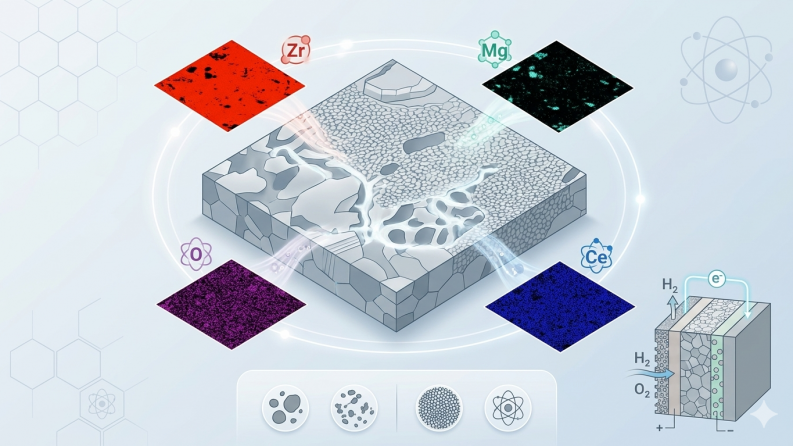
Objective of the project – The aim of the project is to study the applicability of modified composite nanostructured ceramics based on compounds of zirconium, cerium and magnesium oxides as materials for fuel cells for hydrogen production.
Relevance: The relevance of the project is driven by the need to increase the share of renewable energy sources in Kazakhstan and to reduce harmful emissions within the framework of international initiatives (COP28, Atom4NetZero). Developing efficient and economically viable alternative energy technologies requires creating new materials with high performance and durability.
In this regard, the development of nanostructured ceramics for solid oxide fuel cells, possessing high conductivity, thermal stability, and long service life, represents an important scientific and technical task aimed at enhancing the efficiency and profitability of next-generation energy systems.
Scientific supervisor: Zikirina Ainur Mukhametzhanovna, PhD
Expected and achieved results: In the first year of the project implementation, using a combination of analysis methods used in solid state physics, such as scanning electron microscopy, X-ray phase analysis, thermogravimetry, optical and Raman spectroscopy, data will be obtained on the kinetics of phase transformations in ternary systems MgO – CeO2 – ZrO2 ceramics, on the basis of which optimal conditions for obtaining ceramics with a stable phase composition will be determined, excluding the processes of polymorphic transformations during operation.
The second year of the project will be aimed at conducting experiments to test samples of MgO – CeO2 – ZrO2 ceramics for resistance to high-temperature degradation, which will allow us to determine not only the influence of the stabilizing component MgO on the resistance of ceramics to oxidation and volumetric swelling, but also to establish the kinetics of ceramic degradation, the results of which will make it possible to determine the main mechanisms of corrosion and structural disorder depending on the high-temperature test modes.
The third year of the project will be associated with testing samples of MgO – CeO2 – ZrO2 ceramics as anode materials for solid oxide fuel cells, including determination of electrochemical characteristics, as well as the efficiency of hydrogen production depending on the composition of the ceramics, the change of which affects the ion-electron conductivity.
The relevance of the research consists in the creation of an inexpensive method for producing materials for fuel cells that have high capacitive characteristics, as well as resistance to high-temperature degradation associated with the operating modes of fuel cells, the reduction of which is currently one of the most difficult problems to solve in the field of creating solid oxide fuel cells.
The work was carried out on the synthesis of MgO – CeO2 – ZrO2 ceramics using mechanochemical activation and thermal annealing methods. As a result of the experiments, a series of ceramic samples was obtained, and their characterization was performed using scanning electron microscopy, X-ray phase analysis, and mechanical strength testing methods.
The scientific novelty of the project lies in the determination of technological solutions for the creation of nanostructured composite ceramics based on the MgO – CeO2 – ZrO2 ternary system, which possess high capacitance characteristics, thermal stability, and long service life.