
AP26103767 – Optimization of design methods for centrifugal pumps based on modern mathematical modelling of hydrodynamic processes and artificial intelligence
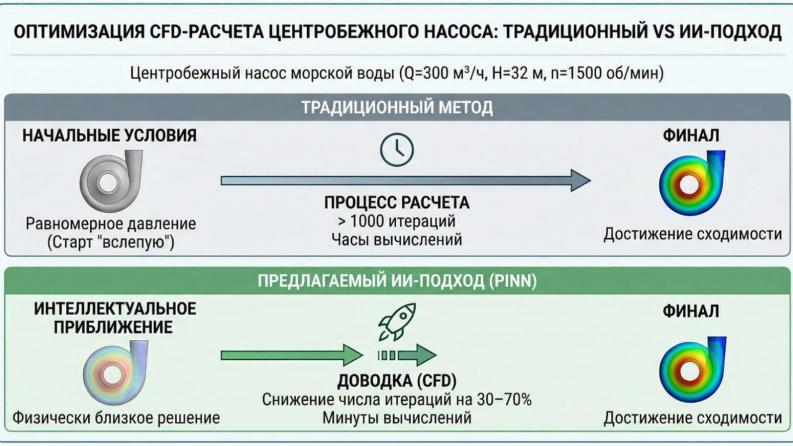
Objective of the project – to develop a hydrodynamic model to describe the flow behavior and processes occurring in a centrifugal pump, as well as to explore the application of a hybrid approach using artificial intelligence to accelerate computations.
Relevance: The relevance of this project is driven by the high time and financial costs associated with traditional laboratory-based optimization of pump designs, which requires the creation of numerous physical prototypes. Mathematical modeling offers a more efficient alternative, but it demands significant computational resources due to the complexity of hydrodynamic processes, including turbulence. Each simulation involves solving multiple differential equations on large computational grids, often exceeding millions of nodes, which substantially increases calculation time. The need to evaluate pump performance across various flow rates and geometric configurations further multiplies the computational workload. As a result, optimization processes become extremely time-consuming and resource-intensive, limiting the speed of engineering development. Therefore, the project is highly relevant as it aims to develop advanced computational approaches, such as neural networks and parallel computing, to accelerate simulations while maintaining high accuracy.
Scientific supervisor: Ph.D., Shayakhmetov Nurlan Muratkhanovich
Expected and achieved results: The project achieved comprehensive results in analyzing modern methods for the design and modeling of centrifugal pumps. A detailed literature review was prepared based on the analysis of more than 70 scientific publications, covering theoretical, empirical, numerical, experimental, and combined approaches. The study identified key advantages and limitations of theoretical-analytical and empirical-hydraulic methods, particularly their limited applicability and dependence on experimental data. Advanced numerical methods based on computational fluid dynamics (CFD) were analyzed, including RANS, LES, and DNS models, highlighting their capabilities in simulating complex hydrodynamic phenomena such as turbulence, cavitation, and energy losses. It was established that RANS models provide an optimal balance between accuracy and computational efficiency, with prediction errors of 3–10% and relatively low computational costs. LES methods were shown to offer higher accuracy (1–2%) and better resolution of unsteady flow structures but require significantly higher computational resources. DNS demonstrated the highest accuracy (less than 1% error) but was found impractical for industrial applications due to extremely high computational demands. A comparative analysis of turbulence models was conducted based on accuracy and computational speed, confirming that model selection is a trade-off between precision and resource requirements. The results also emphasized the importance of experimental methods for validating numerical simulations and improving model reliability. Furthermore, combined approaches integrating analytical, numerical, and experimental methods were identified as the most effective for improving design accuracy. Overall, the project established a solid scientific and methodological foundation for optimizing centrifugal pump design using modern computational techniques.