
AP26103573 – Development of a model and digital tool for designing and calculating technical-economic parameters of seasonal thermal energy storage system to improve efficiency, assess the possibility of integration with other technologies
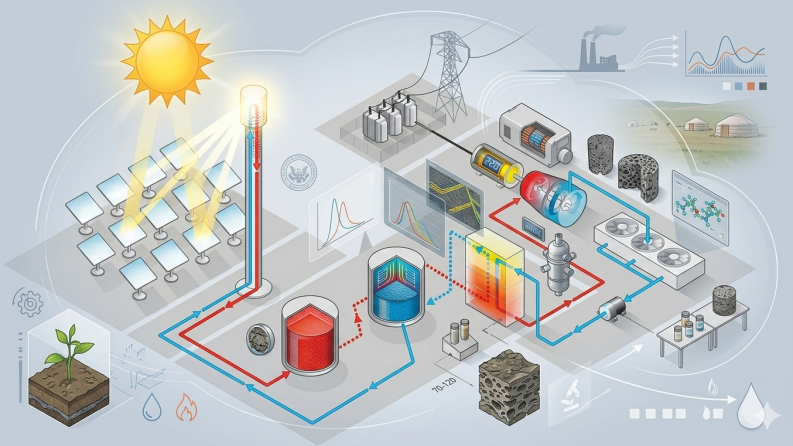
Objective of the project – Development of a digital tool for designing a seasonal thermal energy storage technology with a dynamic thermal load depending on the needs of the consumer. The proposed tool will account for the heterogeneity of the soil, groundwater flows, and also include methods for determining the thermophysical properties of subsurface soil layers. In addition, the tool will contain a methodology for assessing the technical and economic indicators of the technology to optimize heat storage processes, improve resource efficiency and provide sound decisions for operating the system in various climatic and geological conditions with an emphasis on economic feasibility and long-term benefits.
Relevance: The relevance of the project is driven by the need to improve energy efficiency and reduce CO₂ emissions in the sharply continental climate of Kazakhstan, where a significant share of energy consumption is attributed to heating, often relying on coal. Seasonal thermal energy storage (STES) technology based on geothermal heat accumulators enables efficient heat storage and utilization, ensuring energy supply stability and improving environmental conditions. However, the lack of advanced digital design tools that account for geological heterogeneity and groundwater limits the implementation of such systems, making the development of an integrated model and digital tool a highly relevant task.
Scientific supervisor: Aizhulov Daniar, PhD, Senior Lecturer
Expected and achieved results:
During the project implementation, it is expected that a comprehensive dynamic model of the seasonal thermal energy storage system will be developed, which will allow achieving significant quantitative and qualitative results corresponding to the established goals and objectives.
Main result of the study: creation of a verified mathematical model integrating the heat exchange of borehole heat exchangers with refined thermophysical properties of the soil. It is expected that the model will include all key components of the system, such as solar collectors, short-term heat accumulators and borehole heat exchanger networks, and also take into account the seasonal and climatic loads typical for the regions of Kazakhstan.
Form of implementation of results.
During the implementation of the project, the following will be published in accordance with the competition documentation.
Scope and target consumers: the project results will be useful for research institutes, government agencies, energy companies and private investors interested in the implementation of thermal energy storage systems. The use of this model will ensure more efficient use of solar resources and optimization of heating systems.
Impact on the scientific direction: it is expected that the developed model will significantly affect the development of science in the field of heat engineering and renewable energy sources, and will also have a positive effect on related areas, such as geothermal energy and ecology.
Commercialization of results: the results obtained can be used to create new business models in the field of energy, which opens up opportunities for their commercial application and introduction to the market. This can also lead to a reduction in heat exchange costs and improved energy efficiency. Socioeconomic and environmental impact: The project contributes to solving current problems in the field of energy security and sustainable development, which is especially important for Kazakhstan. It is expected that dependence on fossil energy sources will decrease, as well as the carbon footprint will be reduced, which will have a positive impact on the environmental situation in the country.
Based on the results of the research under this project, a doctoral student and a master's student will be trained.
Thus, the expected results of the research will not only be significant from a scientific point of view, but also practically applicable, which will ensure their demand in various fields.
As a result of the conducted research, a mathematical model of heat transfer processes in a borehole heat exchanger was developed using a pseudo-three-dimensional approach, along with a comprehensive mathematical model describing heat transfer and filtration processes in the system of borehole heat exchangers and surrounding soil.
The scientific novelty of the obtained results lies in the development of an efficient computational method for modeling ground thermal energy storage systems with extreme geometric ratios (diameter-to-length ratio of up to 1:5000), combining sufficient accuracy with minimal computational costs.
For the first time under the conditions of Kazakhstan, a comprehensive model was developed that accounts for the combined influence of heat transfer and groundwater filtration processes on the performance of borehole heat exchangers, which is of fundamental importance for regions with active groundwater movement.
The established relationships between hydrogeological parameters and system operating modes and their impact on heat extraction efficiency provide a theoretical basis for optimizing the design of ground-based thermal energy storage systems, taking into account the specific climatic and geological conditions of the region.