
AP26102323 – Optimization of Efficiency and Configuration of High-Temperature Heat Pumps for Integrating Renewable Energy Sources and Utilizing Waste Heat
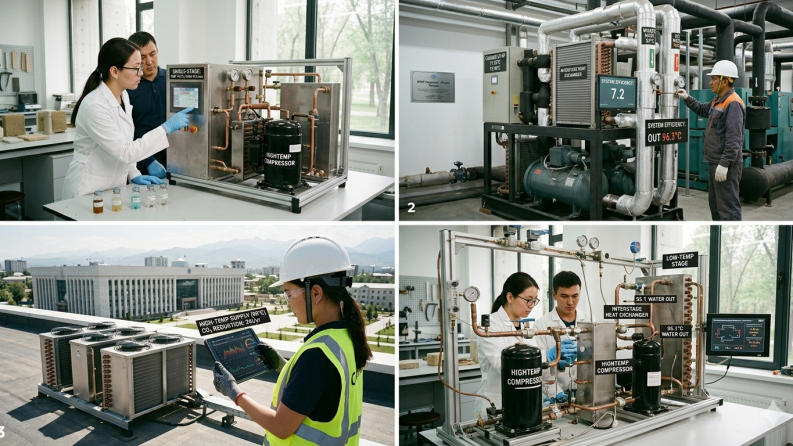
Objective of the project – The project aims to develop and optimize an efficient system for generating high-temperature (60–100 °C) useful heat using a vapor-compression heat pump. The project is focused on researching and identifying optimal configurations of single-stage and two-stage cascade heat pumps designed to convert low-grade renewable heat and/or utilize waste heat. The project aims to develop and optimize an efficient system for generating high-temperature (60–100 °C) useful heat using a vapor-compression heat pump. The project is focused on researching and identifying optimal configurations of single-stage and two-stage cascade heat pumps designed to convert low-grade renewable heat and/or utilize waste heat.
Relevance: The relevance of the project lies in the need to improve the energy efficiency of industrial and service facilities through the integration of renewable energy sources and the utilization of waste heat. Existing heat pumps are limited to low operating temperatures, whereas industries require heat at 60–100 ℃ and above. Optimizing high-temperature heat pumps will enable efficient conversion of low-potential heat, reduce the carbon footprint, and improve the economic and environmental performance of enterprises.
Scientific supervisor: Belyaev Erzhan Kelesovich, PhD, Associate Professor, Research Professor
Expected and achieved results:
The expected results of the Project include the optimization of efficiency and configuration of vapor-compression heat pumps for generating high-temperature (60-100 °C) heat, determining optimal heat pump configurations for efficient conversion of renewable heat sources and waste heat utilization, as well as the selection of environmentally friendly refrigerants and blends with zero ozone depletion potential and low global warming potential. A key result will be the accumulation of significant volumes of numerical and experimental data, its statistical processing, and analysis, which will improve existing optimization models.
The requirements for the expected results of applied research in the field of engineering and technology will be fulfilled in accordance with Section 7 of the competition documentation. Section 9 of the application outlines the publication plan for the entire project implementation period. Publication activities will be carried out in line with this plan and the requirements specified in the competition documentation.
As part of the project, one PhD candidate, Yelnar Yerdesh, is expected to defend their thesis at the Dissertation Council for Mechanics at Al-Farabi KazNU within the designated timeframe. Yerdesh Ye. serves as the project’s main executor.
Currently, the project’s Technology Readiness Level (TRL) is at level 3, corresponding to the development and laboratory testing of key technological components. By the end of the project, the TRL is expected to reach level 4, including the creation of a laboratory prototype and the execution of experimental validation.
The impact of the expected results on the development of the main scientific direction and related areas of science and technology lies in the development of interdisciplinary research in fields such as engineering thermodynamics, heat and mass transfer, high-temperature flow physics, fluid mechanics, computational fluid dynamics (CFD), solar thermal systems, and environmentally safe refrigerants. The Project involves young researchers with experience in developing experimental prototypes of heat pumps, solar thermal systems, and thermal storage systems using phase change materials (PCM). The knowledge gained will be applied in the Project and shared with students, master's, and PhD students at Satbayev University and Al-Farabi Kazakh National University. The results will be of practical value to researchers and entrepreneurs in thermal equipment and heating systems, as well as to the industrial sector.
The social, economic, environmental, and scientific-technical impact of the Project lies in training young specialists in scientific and engineering fields. Students will acquire knowledge and skills in the development and optimization of thermal equipment, thermal process modeling, and energy system analysis. The natural science component will be implemented at Al-Farabi Kazakh National University, while the engineering part will be carried out at Satbayev University, with a focus on experimental work.
1.1 An optimization calculation model based on an endoreversible thermodynamic model has been developed to determine the dimensions and efficiency of heat exchangers, as well as to account for the thermophysical properties of intermediate heat carriers for single-stage and two-stage cascade heat pumps.
1.2 Calculations of various single-stage and two-stage cascade configurations of vapor-compression heat pumps were performed using the developed optimization model, and different optimization criteria were tested.
1.3 The calculation and selection of components for a laboratory prototype of a “Water-to-Water” heat pump were carried out.
The novelty of the 2025 research lies in the development of the endoreversible thermodynamic model and the optimization algorithm.