
AP26101911 – Vacancy defects in MXene: their study and application for obtaining MXene/cryogel hybrid filter with improved sorption properties for water purification
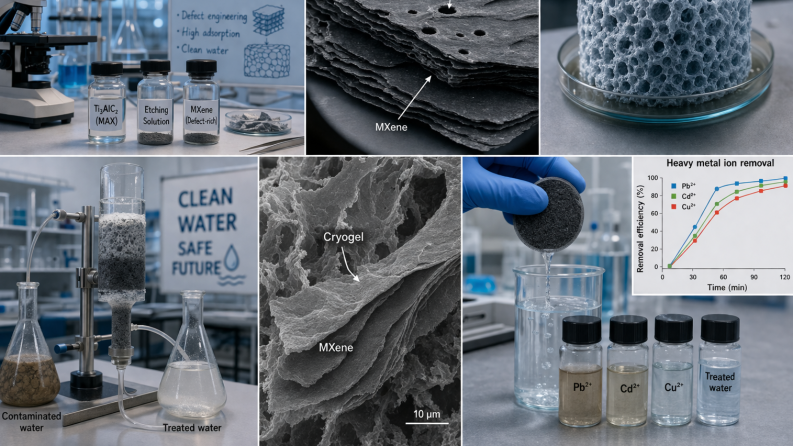
Objective of the project – The aim of the project is to fabricate hybrid filters for water purification from heavy metal ions and other pollutants. To obtain hybrid filters from MXene/cryogel composites, methods will be developed for obtaining MXene with vacancy defects on the MXene surface to increase sorption sites, and macroporous polymers with complementary characteristics will be synthesized.
Relevance: The relevance of the project is driven by the urgent problem of water contamination with toxic heavy metal ions, which threatens the health of over 2 billion people worldwide, including in Kazakhstan, where more than 100 water bodies exceed permissible concentrations. Existing water purification methods are insufficiently effective, making the development of new materials and filters highly important. Research on MXene with defect vacancies as adsorbents for heavy metals and the creation of hybrid filters based on them combined with macroporous cryogels represents an innovative direction capable of improving water purification efficiency and reducing environmental risks.
Scientific supervisor: Baimenov Alzhan Zhuldasovich, PhD in Science, Engineering and Technology, Associate Professor of Chemistry
Expected and achieved results:
The expected results of the project will be the production of an adsorbent based on MXene and cryogel, fully characterized by modern physical and chemical methods of analysis. Detailed development of methodologies for the synthesis of defective MXene, conducting experiments in compliance with all ethical standards will improve the professional level of scientific and technical potential of young scientists, including bachelors and masters, who are planned to be involved in the project, and will also increase the competitiveness of Satbayev University as a leading research center at the national and global levels. Cooperation with leading scientists from foreign universities and research centers will expand the existing scientific groundwork in the field of composite materials and the production of new materials. International exchange will allow young scientists to gain new knowledge and skills in the field of advanced design methods and determination of material characteristics.
The results show that increasing the etching time and the acid-to-MAX phase ratio allows controlled defect formation. The synthesized samples were tested for the removal of copper ions from model solutions and multicomponent mixtures. It was found that defect-containing MXene can remove more than twice as many copper ions and at a faster rate compared to MXene produced by the standard method. The adsorption mechanism was studied, demonstrating that defect MXene removes copper ions through complexation and chelation.