
AP26100359 – Development of technology for complex processing of asbestos wastes with obtaining magnesium salts, iron and nickel concentrates and metallic silicon.
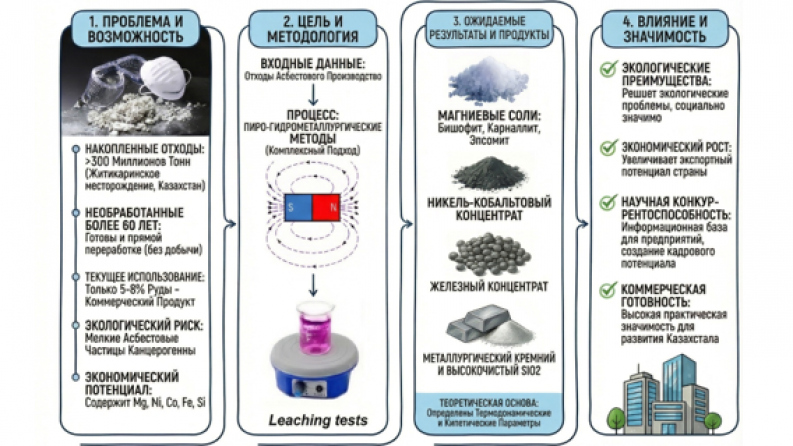
Objective of the project – The aim of the project is to develop a technology for obtaining magnesium salts, iron and nickel concentrates, and metallic silicon through the comprehensive processing of asbestos waste. Additionally, the project seeks to enhance the theoretical foundation of metallurgical processes by determining the thermodynamic laws, kinetics, and mechanisms of the processes carried out during the research work for technology development.
Relevance: During the processing of chrysotile-asbestos mineral from the Zhitikara deposit in the Kostanay region, more than 300 million tons of oxide waste have accumulated to date. The selective extraction and conversion of valuable components contained in these wastes into marketable products is a study of significant economic and environmental importance for our country. This is because the waste contains millions of tons of highly demanded metals such as magnesium, nickel, cobalt, iron, and silicon, lying on the ground in a crushed state ready for processing. According to numerous calculations, an economically efficient technology involves processing these technogenic wastes directly in their ready state, without mining or quarrying operations, and sending them immediately to beneficiation and metallurgical processes.
Processing these wastes provides not only technological but also environmental and social benefits. The current asbestos ore processing technology at the asbestos plant extracts only 5–8% of the ore as marketable products, while over 90% is discarded into waste stockpiles. As a result, millions of tons of waste have accumulated in the plant’s area. According to the World Cancer Research Agency, waste processing is considered socially significant, as fine asbestos particles are classified as carcinogenic substances. The technology proposed in our project will not only solve environmental problems associated with processing these wastes but also enhance the country’s export potential through the production of metal concentrate products.
Scientific supervisor: Baigenzhenov Omirserik Sabyrzhanovich, PhD, Associate Professor
Expected and achieved results:
As a result of the research work, the optimal parameters for the technology of producing magnesium chloride salts, nickel, cobalt, and iron concentrates, as well as metallic silicon, will be determined. Additionally, a theoretical research base will be developed to define the thermodynamic and kinetic parameters of the pyrometallurgical and hydrometallurgical processes under study.
- either at least 2 (two) articles and/or reviews in peer-reviewed scientific publications indexed in the Science Citation Index Expanded and included in the 1st (first) and/or 2nd (second) quartiles by impact factor in the Web of Science database and/or having a CiteScore percentile in the Scopus database of at least 65 (sixty-five);
- at least 2 (two) articles or reviews in a peer-reviewed foreign or domestic publication recommended by the Committee on the Protection of the Rights of Scientific and Cultural Organizations;
The effectiveness of a two-stage technology (magnetic beneficiation + sulfuric acid leaching) for extracting nickel and cobalt from chrysotile-asbestos waste has been established. Optimal process parameters were determined: during magnetic separation, the magnetic fraction yield was 4–6% with a nickel content of up to 2.17%; during leaching, 67% of nickel and 48% of cobalt were extracted under conditions of 75 °C, 120 minutes, and 4 M H₂SO₄.