
AP23490705 – Research and development of an autonomous weed destroyer robot with artificial intelligence
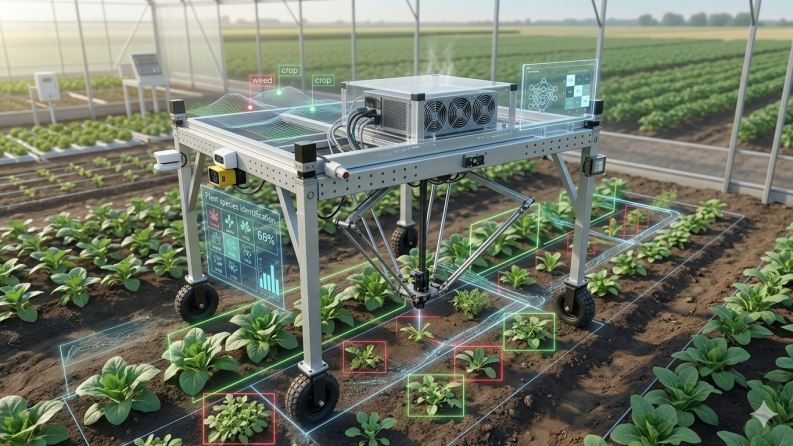
Objective of the project – The goal of this project is to create a model of a weed destroyer robot with artificial intelligence, improving the technological process of destroying weeds using active knives.
Relevance: Controlling perennial weeds is a pressing issue in the context of global warming, as they compete with crops for nutrients. The use of chemical herbicides harms the environment, increases farmers’ costs, and affects the price of produce. Traditional methods of spraying entire fields with chemicals are ineffective and damage crops. Weeds also contribute to the spread of pests and degrade soil and water quality. Manual weed removal is labor-intensive, and labor shortages further exacerbate the problem.
Scientific supervisor: Ph.D., Associate Professor, Nugman Yerik
Expected and achieved results: A conceptual design for an autonomous weed-control robot was developed, and its dimensions and component layout were determined. Based on the analysis, a 3D model of the robot equipped with artificial intelligence was created, and a prototype was assembled. Algorithms based on the YOLOv5 Large model were improved to increase the accuracy of weed recognition. Algorithms for determining the coordinates of weed roots and controlling the movement of the cutting blade were developed. The blade’s speed and momentum parameters were optimized, and design modifications were made. A test platform was created on which all modified components were tested. Based on the results obtained, technical requirements for improving the robot control system were formulated. During the refinement process, the control system was upgraded using an STM32F4 microcontroller, and wheel control accuracy was improved. A field-testing methodology was developed, and experimental studies were conducted using a computer vision system. The studies covered weed detection, optimization of movement trajectories, and cutting blade parameters. As a result, at a speed of 0.1 m/s, the robot demonstrated 90–95% weed removal efficiency without damaging crops. The implementation of an autonomous robot reduces labor costs, improves processing quality, and eliminates the need for chemicals.