
AP23489790 – Investigation of water vapor interaction with beryllides of different grades at critical and supercritical water vapor parameters
Objective of the project – The aim of the proposed project is to study high-temperature corrosion processes of binary intermetallic compounds based on beryllium (beryllides) at critical and supercritical steam parameters corresponding to similar steam parameters at the turbine unit inlet.
Relevance: An important task in the development of energy systems, including nuclear and thermonuclear power, is to increase the efficiency of power units by raising steam temperature and pressure to supercritical and ultra-supercritical parameters. The efficiency of a steam turbine unit directly depends on the difference in pressure and temperature of steam at the inlet and outlet of the turbine. Currently, most turbines at nuclear power plants of the VVER, PWR, and BWR types operate on saturated steam with relatively low parameters. With the transition to advanced high-temperature reactors and increasing turbine unit capacity, steam parameters will continue to rise. The most heavily loaded components are the first stages of the high-pressure turbine cylinder, which operate under extreme temperature and pressure conditions. As a result, the requirements for turbine blade materials are increasing. Intermetallic compounds of beryllium with other metals, due to their high thermal and mechanical properties, are considered promising materials.
Scientific supervisor: Candidate of Physical and Mathematical Sciences, Kulsartov Timur
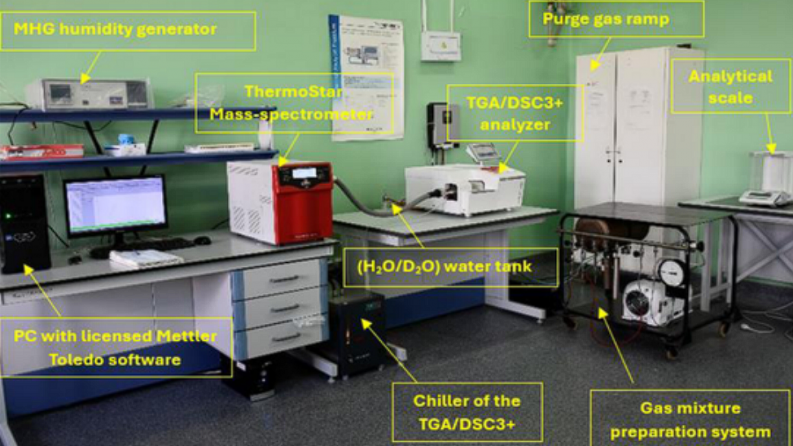
Expected and achieved results: The results of corrosion experiments on various types of beryllides were obtained in the form of a dataset including test diagrams and characterization data of samples before, during, and after testing. Experiments on titanium and chromium beryllides were carried out in the temperature range of 300–500 °C and at water vapor pressures of 8–25 MPa, with an exposure time of 3 hours for each test. For this purpose, a dedicated experimental module, CorSiCa, was developed and constructed to ensure hermetic conditions and precise control of environmental parameters. The setup is equipped with a system for generating gas mixtures and water vapor, pressure sensors, and an automated temperature control system. During methodological experiments, the measurement systems were calibrated and operating parameter ranges were established: temperature 20–700 °C, water vapor pressure up to 3×10⁶ Pa, and residual gas content not exceeding 10 ppm. Testing procedures were developed and optimized, including sample preparation and extraction without contact with atmospheric gases. The obtained results demonstrated high corrosion resistance of beryllides under water vapor conditions close to critical parameters. A slight mass gain and the formation of thin oxide films were observed. It was found that titanium beryllide Be12Ti exhibits higher corrosion resistance compared to Be12Cr. This is evidenced by lower mass gain and thinner oxide layers at all tested temperatures. The results provide a basis for further research and for selecting materials for high-temperature energy systems.
List of publications with links to them
- Kulsartov T. Comparative analysis of high-temperature corrosion processes of beryllides of different compositions / T. Kulsartov, I. Kenzhina, K. Samarkhanov et al. // Fusion Engineering and Design. – 2025. – Article 115283. – URL: https://doi.org/10.1016/j.fusengdes.2025.115283