
AP23489574 – Modified activated carbon packing media -driven advanced removal of dissolved organic matter and microplastic during slow filtration of reused water
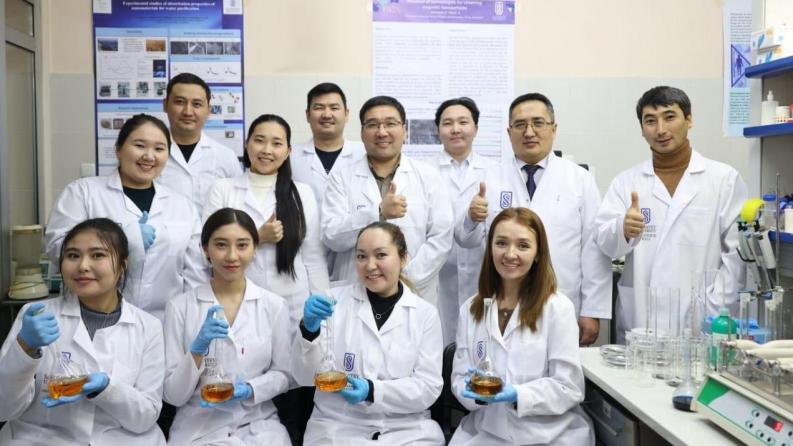
Objective of the project – The goal of the project is to develop and validate advanced water treatment technology capable of removing dissolved organic matter (DOM) and microplastics (MP), including microfibers (MF), from reused water.
Relevance: Water reuse is one of the key solutions to the global water scarcity crisis, which is particularly relevant for Kazakhstan, where the Ministry of Water Resources and Irrigation was established in 2023. The main contaminants in reused water are dissolved organic matter (DOM) and microplastics, which may contain hazardous components and precursors of disinfection by-products. Therefore, they must be removed as efficiently as possible prior to conventional drinking water treatment. In Kazakhstan, projects are being implemented to construct and modernize wastewater treatment plants with the introduction of automated systems for water reuse. In this context, a universal multifunctional filtration technology is proposed to optimize existing water treatment systems. Satbayev University has a proof-of-concept for a pilot-scale slow filtration system at Technology Readiness Level TRL4, with prospects for implementation at real facilities (TRL6). The sorbent used is a multimedia filter consisting of a sand layer and modified activated carbon, including iron oxide (FexO)-modified carbon, aimed at reducing DOM and microplastics content. It is expected that the filter will reduce contaminant concentrations by up to 50% per cycle and operate effectively over a wide pH range. The results of the study are planned to be published in Q1 journals, presented at national and international conferences, and used for training young researchers and strengthening scientific collaboration.
Scientific supervisor: Ph.D., Professor, Azat Seitkhan
Expected and achieved results: The maximum sorption capacity of activated carbons was determined under laboratory conditions, and equipment for slow filtration of wastewater was also acquired. Experiments with samples 0.5 M WN–KOH–FeCl and 1 M WN–KOH–FeCl showed that the former has a higher sorption capacity, reducing the optical density of methylene blue solution to 0.051 at a concentration of 400 ppm within 90 minutes. The 1 M sample was effective only at lower concentrations (10–200 ppm), indicating its lower efficiency. To model microplastics, a PET suspension with carboxymethyl cellulose was used and filtered through various columns containing sand, zeolite, and modified sorbents. It was found that filters with modified activated carbon provide a higher degree of microplastic removal. Wastewater sampling was carried out in the Almaty region before and after biological treatment. A patent of the Republic of Kazakhstan No. 10022 was obtained for a method of producing a composite diatomite membrane. One scientific article and one book chapter were published. The parameters for the synthesis of activated carbons from agro-waste were optimized, including carbonization temperature (500 °C), activation temperature (800 °C), and the KOH ratio of 1:2. It was established that FeCl₃ modification (0.5 M) improves sorption properties, whereas increasing the concentration to 1 M reduces efficiency. The synthesized materials are recommended for the purification of water from organic pollutants and microplastics. A pilot-scale wastewater treatment unit with a capacity of up to 20 m³/day was developed and implemented. The technology includes stages of biological treatment, a membrane bioreactor (MBR), reverse osmosis, and slow filtration using FeₓO-modified activated carbon. The system is fully automated based on a Siemens PLC and ensures stable water quality indicators (COD ≈ 15 mg/L, BOD₅ ≈ 25 mg/L). Installation, commissioning, and testing confirmed the reliability and efficiency of the system. The unit has been put into pilot operation at LLP “LUKOIL Lubricants Central Asia” and is used to optimize wastewater treatment.
List of publications with links to them
- Sapargali I.O., Bekseitova K.S., Zhantikeev U.E., Nurgaliyev N.N., Azat S. A comprehensive method for microplastic removal in water using sorbents // Bulletin of Shakarim University. Technical Sciences. – 2025. – No. 1(17). – DOI: https://doi.org/10.53360/2788-7995-2025-1(17)-51
- Mussa N., Amantaiuly K., Azat S., Amrousse R., Toshtay K. Modification of diatomite mineral sorbent for the cleanup of petroleum spills on water surfaces // Eurasian Chemico-Technological Journal. – 2025. – Vol. 27. – P. 101–110. – DOI: https://doi.org/10.18321/ectj1658
- Dai G., Xu X., Seitkhan Azat. Prospects and applications of metal–organic frameworks (MOFs) for efficient degradation of toxic organic dyes in aqueous media // Colloids and Nanotechnologies in Industry 2025: Proceedings of the International Scientific and Technical Conference. – Almaty, 2025. – P. 18–23.
- Jia L., Seitkhan A., Adam M.R. Green synthesis of rice husk-based SiO₂@Fe₃O₄ magnetic nanocomposites: a sustainable adsorbent for water treatment // Colloids and Nanotechnologies in Industry 2025: Proceedings of the International Scientific and Technical Conference. – Almaty, 2025. – P. 328–333.
- Qu Z., Seitkhan A., Binti Yusof N.N. Adsorption of heavy metals on magnetic zeolites: a review // Colloids and Nanotechnologies in Industry 2025: Proceedings of the International Scientific and Technical Conference. – Almaty, 2025. – P. 351–353.
- Guo X., Seitkhan A. Sustainable synthesis of TiO₂/SiO₂ nanocomposites from titanium powder and mining waste for photocatalytic applications // Colloids and Nanotechnologies in Industry 2025: Proceedings of the International Scientific and Technical Conference. – Almaty, 2025. – P. 375–379.
- Sultakhan Sh., Baibotayeva A., Azat S. Transforming waste into solutions: novel water treatment technologies for a sustainable future // XVI International Symposium on Combustion and Plasma Chemistry. Physics and Chemistry of Carbon and Nanoenergetic Materials: Book of Abstracts of International Symposium. – Almaty, 2025. – P. 81.
- Khalkhabay S., Sultakhan Sh., Seitkhan A., Kuldeyev E. Slow sand filtration for water treatment // Mabrouk A., Bachar A., Azat S., Amrousse R. Innovative Materials for Industrial Applications: Synthesis, Characterization and Evaluation. – Hershey, PA: IGI Global, 2025. – P. 75–91.
- Алсар Ж.Т., Гаджимурадова А.М., Тыныштыкбаев К.Б., Серик Н.Г., Сейтхан А., Кульдеев Е.И., Инсепов З.А. Способ получения композитной диатомитовой мембраны для медленной фильтрации воды: патент на полезную модель № 10022 Республики Казахстан, опубл. 05.01.2025. – Казахстан, 2025.