
AP23489285 – Investigation of two-phase lithium ceramics degradation processes as a result of hydrogenation and helium swelling
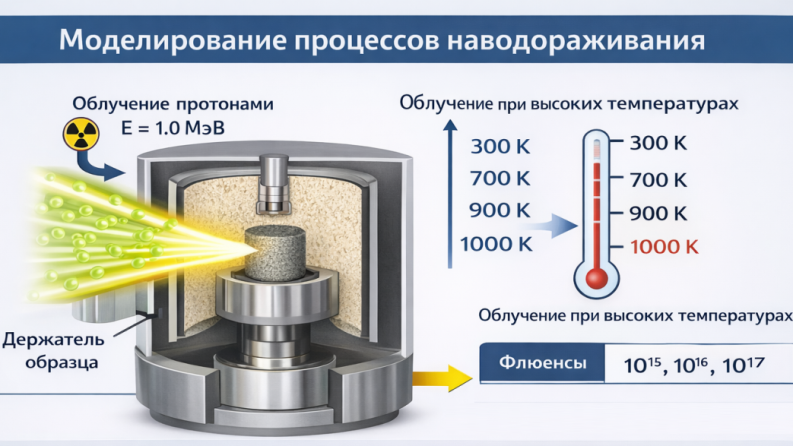
Objective of the project – The aim of the project is to study degradation processes in two-phase ceramics based on LiAlO2 - Li2ZrO3 compounds under high-dose irradiation with protons and helium ions, modeling the processes of hydrogenation and helium swelling in ceramic blanket materials intended for tritium production.
Relevance: The relevance of the project is determined by the growing energy crisis associated with the continuous increase in energy consumption and the need to reduce the use of fossil fuels. Under these conditions, the development of alternative energy sources becomes particularly important, among which thermonuclear and hydrogen energy are considered the most promising. These approaches are based on the use of safer fuels, such as hydrogen and tritium, which reduces environmental risks compared to conventional nuclear energy. An additional advantage is the reduction in the accumulation of long-lived radioactive waste. At the same time, the sustainable development of thermonuclear energy is limited by the problem of ensuring a sufficient supply of tritium. Existing methods of its production are not capable of fully meeting the growing demand. Therefore, the search for efficient tritium production technologies becomes highly relevant. One of the most promising solutions is the use of lithium-containing ceramics, in which tritium is generated through the nuclear reaction Li(n,α)T. Particular interest is focused on two-phase ceramic materials that demonstrate enhanced resistance to radiation damage and degradation processes. Their application can improve the reliability and durability of materials under thermonuclear reactor conditions, which makes this research direction highly relevant.
Scientific supervisor: Ph.D., Associate Professor, Petr Blynsky
Expected and achieved results: Within the framework of the project, two-phase LiAlO₂–Li₂ZrO₃ ceramics were obtained and characterized, and their structural properties (phase composition, lattice parameters, density, porosity, and crack resistance) as well as thermophysical properties (thermal conductivity) were studied depending on synthesis conditions. Characterization of samples produced by mechanochemical activation followed by thermal annealing was carried out. It was established that an increase in the Li₂ZrO₃ content enhances mechanical strength, hardness, and crack resistance, while the dominance of LiAlO₂ leads to higher thermal conductivity. It was also shown that the phase ratio affects porosity, decreasing it when Li₂ZrO₃ dominates, which contributes to improved mechanical stability. The mechanisms of hydrogen accumulation in ceramics under high-dose proton irradiation were studied, and the dependencies of changes in structural, mechanical, and thermophysical properties were identified. It was found that interphase boundaries in two-phase ceramics limit thermal expansion and slow down gas swelling processes by acting as barriers to helium diffusion. Single-phase ceramics were shown to undergo accelerated degradation under high-temperature irradiation, accompanied by structural destabilization and reduced strength. In contrast, two-phase materials exhibit higher radiation resistance and slower defect evolution. It was determined that an increase in irradiation fluence leads to a higher degree of structural disorder and deeper damage layers due to diffusion-driven redistribution of radiation-induced defects. The obtained results confirm the high potential of two-phase LiAlO₂–Li₂ZrO₃ ceramics as advanced materials for application in thermonuclear reactor environments.