
AP09058000 – Study on the catalytic mechanism and properties of materials for water-splitting in natural and artificial photosynthesis
The main objective of the project: The aim of the present research is to study the properties of materials and to clarify the atomistic principles of the catalytic process of water splitting in natural and artificial photosynthesis. The objects of research are the oxygen-evolving complex (OEC) of Photosystem II (PS II), synthetic complexes for artificial photosynthesis.
The relevance of the project: Nowadays the most interesting and more than others mimicking the structural and spectroscopic properties of OEC is the synthetic complex [Mn4CaO4 (ButCO2)8(ButCO2H)2 (py)], obtained by the group of Professor Zhang [14]. The metal cluster of this synthetic complex most accurately reflects the topology and electronic structure of OEC and has Mn4 bonded to CaMnO3 by a cuboid (Fig. 4). We will study the difference vibrational spectra in S2-S1 states of Kok-Joliot cycle, the influence of such properties as the metal oxidation state, its coordination number, types of ligands, the Jahn-Teller effect and the direction of its axis on the characteristic vibration frequencies of carboxyl groups and Mn-O vibrations will be investigated. This project aims to understand the mechanism of water splitting, which can contribute to the complete modeling of catalytic reactions in natural and artificial complexes, as well as lead to the design and development of sustainable artificial photosynthesis devices and solar fuel systems.
Scientific supervisor: Ph.D., Tychengulova Aliya Zhanatkyzy
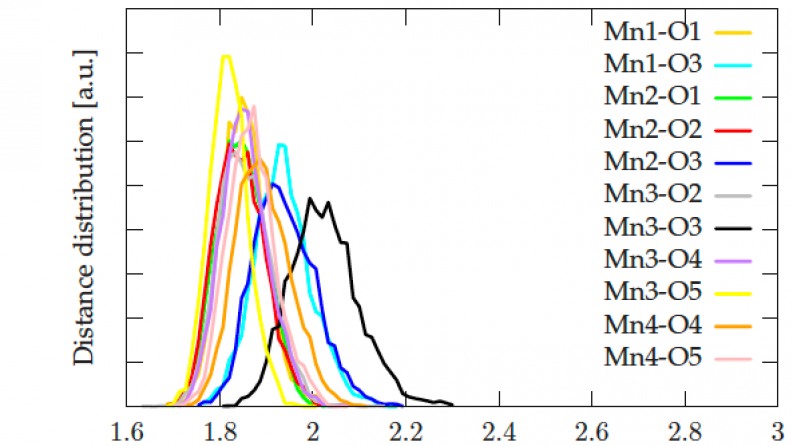
Results obtained: During the research work carried out in 2021–2023, a comprehensive study of the spectroscopic, structural, and magnetic properties of synthetic and natural photosystem II complexes was performed. Infrared spectra were analyzed using quantum chemical methods, enabling accurate interpretation of vibrational modes and identification of optimal computational parameters. The spectroscopic behavior of the oxygen-evolving complex across different Kok cycle states was investigated using advanced modeling approaches, including QM/MM molecular dynamics. Key factors influencing vibrational spectra were identified, and significant differences between synthetic and natural complexes were revealed. New algorithms for spectral analysis and methodologies for modeling photoactivation and oxo-bridge formation were developed. Structural dynamics and O–O bond formation mechanisms were analyzed with consideration of the protein environment. The obtained results contribute to a deeper understanding of water-splitting mechanisms and can be applied in the design of efficient synthetic catalysts.
List of publications with links to them
- Yerezhep D., Tychengulova A., Sokolov D., Aldiyarov A. A Multifaceted Approach for Cryogenic Waste Tire Recycling // Polymers. – 2021. – Vol. 13, No. 15. – P. 2494. – DOI: https://doi.org/10.3390/polym13152494.
- Aldiyarov A., Tychengulova A., Yerezhep D., Ismail A. Vibrational Spectroscopy of Ethanol Molecules Isolated in a Nitrogen Matrix. – Singapore: Springer, 2022. – (Advanced Topics in Science and Technology in China). – DOI: https://doi.org/10.1007/978-981-99-6128-3_124.
- Тыченгулова А., Катпаева К. Исследование начальной стадии фотоактивации в катализаторах на основе Mn // Доклады Национальной академии наук Республики Казахстан. – 2023. – № 347(3). – С. 58–70. – DOI: https://doi.org/10.32014/2023.2518-1483.225.
- Tychengulova A., Katpayeva K., Baurzhan A., Ibragimova S., Yerezhep D., Golikov O., Sokolov D., Aldiyarov A. Laboratory studies of the clathrate hydrate formation in the carbon dioxide–water mixture under vacuum conditions // Materials. – 2024. – DOI: https://doi.org/10.1021/acsomega.4c08342.